Monday, September 10, 2012

Holy Flying Mantas, Batman!

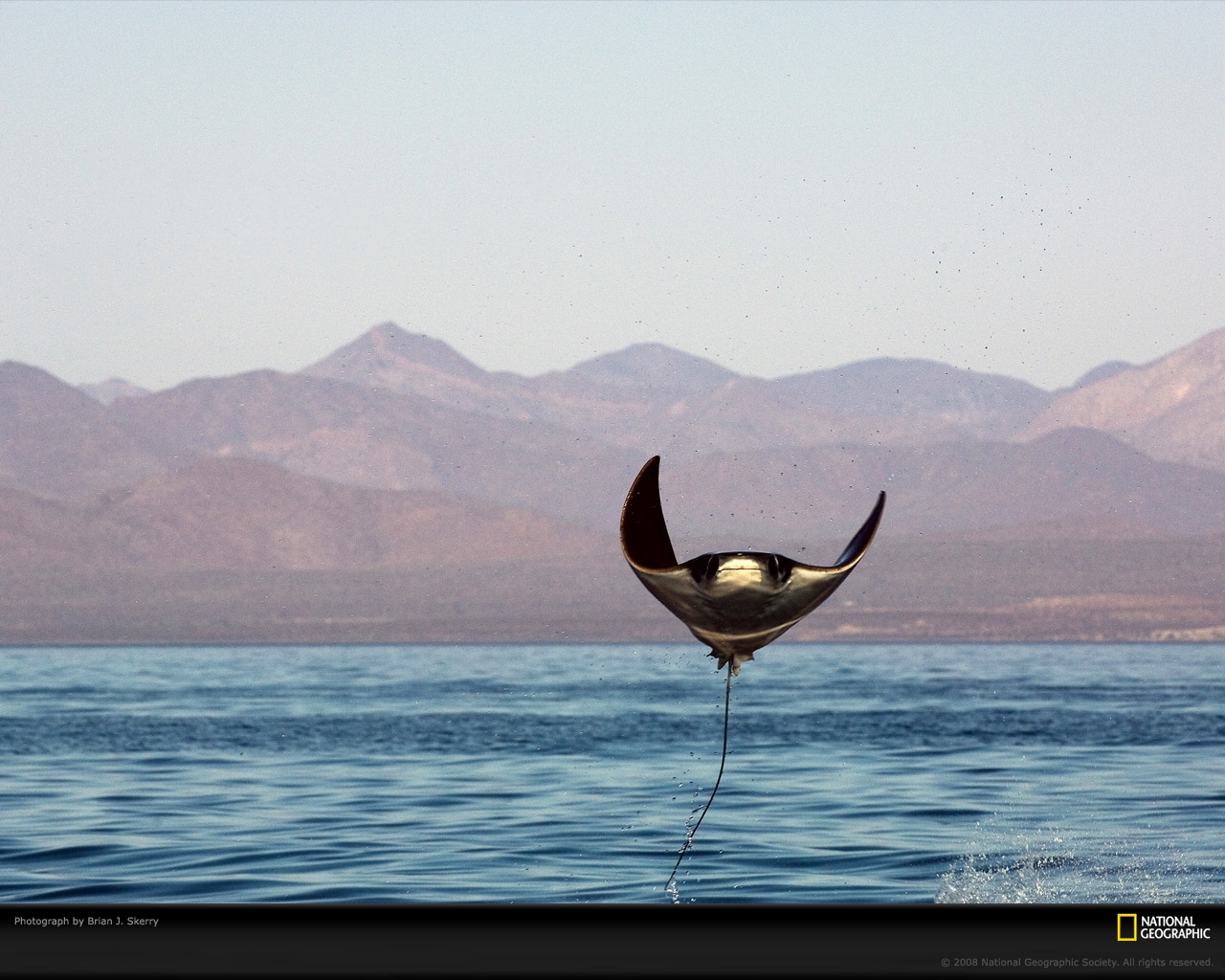
Did you know that manta and mobula rays can leap out of the water up to 9 feet into the air?

http://www.dailymail.co.uk/news/article-1298362/Flying-giants
Most people seem to think it's an impulse to remove parasites, although there are theories that males use the leaps as an effort to attract females or to alert others to the presence of predators. It's a rare sight to document, as rays are migratory and often move across vast areas of ocean. Their graceful movements underwater translate well in the open air, where they flap their fins in a manner reminiscent of flight.

A photo by one of the best underwater photographers, Brian Skerry

Unfortunately for these animals, their species has been listed as 'vulnerable' by the International Union for the Conservation of Nature. They are being overfished for their gill rakers, the membranes in their gills that filter the plankton they feed on. There are dubious claims in traditional forms of Chinese medicine that they strengthen the immune system, can assist in the resolution of kidney problems, and are touted as a general cure-all (much like the shark fin). There is a widespread belief that migratory ocean animals do not get cancer and diseases like humans do, so consuming their meat should be good for you. Unfortunately, most large oceanic animals are no longer safe for consumption at all, as the levels of mercury and chemical by-products in these animals has steadily increased in the last several years.

Don't succumb to an "out of sight, out of mind" mentality; just as you may never have known that these manta and mobula rays can leap out of the water, you might not have known until now that they are in danger of extinction due to irresponsible fishing practices.

Go to Project AWARE's website to learn what action is being taken to save these animals, from legislation to island community organizing and the creation of marine sanctuaries. And take action yourself! Don't be silent in your opposition to unsustainable fishing practices. Raise awareness, sign reputable petitions such as the petition through Project AWARE, and learn more about the successes of these measures and how they benefit the animals.


Thursday, August 30, 2012

Track Your Freshwater Consumption!

One of the projects we should be focused on, not just as divers but as human beings, is the state of our fresh water resources. We at Scuba Emporium are fortunate to live near the greatest natural freshwater resource on the planet: the Great Lakes. However, if this drought has taught Americans anything, it's that our freshwater lakes and rivers are precious commodities. 

Lots of smaller lakes and rivers in the Midwest are closed to swimming due factors such as shrinking shorelines creating drowning hazards and bacteria buildup from lack of fresh water circulation. Other human-related issues include fertilizer runoff encouraging algae blooms and plain ol' sewage. What can we do in the face of our shrinking drinkable water supply?

Use less water!

I found a great resource for tracking your personal water consumption! It's available at the following link: 


This is a great tool to examine your own impact on our freshwater resources and generates helpful tips to use less water. It even offers a 'pledge' option at the end, where (if you want) you can commit to shrinking your water usage. Try it today; you'll be amazed at the unexpected ways you use water.
http://ecofuture.net/greenslogans/slogans-on-save-water/62/


Monday, August 20, 2012

Back to School... Scuba-Style

One of the more popular topics to debate in SCUBA diving is whether or not a given certification agency's Open Water Scuba certification is sufficient training for new divers who will then be released into the wild. I noticed this after I'd had a chance to survey the magazines we get at Scuba Emporium. The topic only comes up every thirty seconds or so (which is especially impressive when you consider that they're monthly magazines).

If you've ever wondered whether or not your level of training will restrict you from, say, wreck diving in Lake Michigan, then you've already taken a step in the right direction. Apprehension or uncertainty about a dive or piece of equipment is a sign that you may want to take another SCUBA class to give you that extra boost of confidence, and give you the expertise that only additional training can provide.

Or take the Underwater Pumpkin Carving specialty... Seriously.
The courses you can take range from continuing education courses like PADI Advanced Open Water and Rescue Diver to specialty courses that train you in the use of specialized equipment (underwater cameras or dry suits) and environments (night and ice). You can also progress into professional diving through the PADI  Divemaster, Assistant Instructor, and Instructor Development course.

Fortunately, we here at Scuba Emporium run the gamut of available PADI con-ed and specialty courses. We're planning dive weekends and trips to teach these courses before the season's over. Check out our calendar for August and September here!

If you think that the fall isn't a good time to start a pro class, think again. Working on Divemaster through the winter is a great idea; you finish all your exams and pool work while it snows, then finish the open water portion with confidence in May.

If you're interested in some of these courses, or curious about how they're run, contact us today! 708.226.1614

Friday, August 10, 2012

Shark Week (Get Excited)!

It's that time again. You've been silently preparing for weeks, stocking up on the snacks, making sure your couch is extra-comfy, and probably watching Jaws for the fiftieth time.

I know, because I've been doing it too. It's time for Discovery Channel's Shark Week which will begin on Sunday, August 12th. And, for those of us who have been uncertain about Shark Week's role in shark conservation over the past few years, we can ease our guilt for watching so ravenously this year, because Discovery Channel is taking on some pretty great partners to help spread the message of conservation.

This year, Discovery announced that it now supports Shark Savers, Oceana, and PEW Charitable Trusts as partners in shark conservation (each of those names is a hyperlink to their site or to their online petitions regarding shark protection. Take a minute and check them out!). This action suggests that the programming on this year's Shark Week will aim at promoting the protection of sharks since it has become more and more obvious that they are extremely vulnerable to overfishing. Ideally, it will also draw attention to the plight of shark suffering at the hand of the shark finning industry, where the sharks are often mutilated by having their fins removed and then thrown back into the sea to drown.  The only way to stop the slaughter is to raise awareness, not only to create marine sanctuaries to protect them but also to make the sale or trade of shark fins illegal, as it already is in California, Oregon, and Illinois.

Thanks, National Geographic!
Shark Savers and Discovery Channel have some pretty great ideas for Shark Week viewers and non-viewers alike. Check out their list of 25 Ways to Help Sharks, which offers some practical tips on actions you can take. Learn more about sharks and their role in the life of the ocean on Discovery's "Shark Facts" page. And if you're a Jaws lover (and let's face it, who isn't?), check out their special on "How Jaws Changed the World" or one of their other great shows. And, of course, sit back, relax, pop some popcorn and get in your couch groove, because it's going to be a great week to watch television.

Saturday, August 4, 2012

Humboldt Squids: the most Dangerous Blobs of Jelly on the Planet?

There are some pretty amazing animals living in the world's water systems. Over the last couple of years, one in particular has been in the public eye off the west coast of the Americas, from Central America to Alaska. This invertebrate is a beautiful but very dangerous squid known commonly as the Humboldt squid or "Red Devil."

discovermagazine.com
The Humboldt Squid is numbered third among the largest squid species, just under the Giant Squid and the Colossal Squid. Averaging sizes up to 6' long and 100 lbs, they are formidable animals to encounter (encounters are not recommended). They are also famous for their aggression, which is what earned them the nickname "red devils" from the Mexican fisherman who fish them in the shrimping off-season. Their skin changes color rapidly, from white to red. Some scientists believe that they use this as a tool to communicate, and perhaps even coordinate an attack on a larger animal. Their tentacles are covered with suckers, and the suckers themselves are lined with small barbs to secure their hold on their prey. Not the best guest to your pool party.


They have also been known to leap out of water and "glide" for yards at a time to avoid predators like sharks and sperm whales.

Beyond that, little is known about them. They spend much of their lives in water too deep for divers to penetrate; we know nothing of their reproductive habits or even the size of their population. What scientists have been watching closely is the expansion of their territory. In years past, they've remained in the Humboldt current off the coast of South America (for which they are named). Over the past few years, they have been sighted as far north as Alaska, prompting concern for the impact they'll have on the local fish population.


Some theorize that climate change has impacted -and expanded- their range. Another popular theory is that overfishing of their predators has given them a free reign of the west coast of North and South America. Of particular concern is the extreme overfishing of sharks, with some shark species showing a 90% population decrease from the pressures of the shark finning industry. As lovely as these squid can be, they could wreak havoc in environments not intended to sustain them.


What can you do? Get involved! Help stop shark finning, and raise awareness of shark overfishing and illegal whaling activities by flexing your political muscle and bringing these issues to public awareness. To learn more about the Humbolt squid and its' cephalopod cousins, you can check out this website created by Dr. James wood of the Waikiki Aquarium: www.thecephalopodpage.org.

Thursday, July 19, 2012

Treasure, Three Miles Deep

The ocean has divulged another closely-kept secret, thanks to the U.K. government and the efforts of an American company called Odyssey Marine Exploration. Odyssey has managed to recover an estimated 48 tons of silver from a World War II wreck called the SS Gairsoppa for the British government, who owns the ship's cargo.

In February 1941 the SS Gairsoppa was sunk by a German U-boat 300 miles off the coast of Ireland. A British merchant ship requisitioned by the British government in wartime, the ship was carrying an estimated 240 tons of silver from Calcutta. It sank in less than 20 minutes after a torpedo cut through the ship, taking down both foremast and radio antenna. The ship sank to 15,420 ft (almost three miles) where it sat, undisturbed, for 70 years.

The Gairsoppa was located by the Odyssey research team in the summer of 2011 after the underwater archaeological company was commissioned by the United Kingdom to raise the cargo. On July 18, 2012, they announced that they had raised an amazing 48 tons of silver bars, worth $38 million. While this is only estimated to be 20% of the total cargo, and only represents the first of several loads, it is already the deepest and largest precious metal recovery ever accomplished.

Odyssey initially inspected the site using ROVs [remotely operated vehicles] and removed the bars by surgically cutting through the steel hulls and decks to allow robotic units to access and remove the silver (pictured above), which was then hoisted to the ship, the Seabed Worker, via its 100-ton active heave onboard crane.

What an amazing story! To learn more or to stay updated on their progress, check out Discovery News or take a peek at Odyssey's website (www.shipwreck.net) for press releases or email updates.

Wednesday, July 11, 2012

Illinois, Speak Now or Forever Deal with Plastic Bags!

Let's consider the impact of single-use plastic bags on our environment for a moment.

Plastic bags are made of an assortment of environmental undesirables, primarily chemical-based, like most other plastic products. These do not break down like natural products such as paper or cotton when they're buried in landfills; rather, they slowly disintegrate, leaving those chemical compounds to filter down into the water table below the landfill. They also are easily caught by the wind, blowing them out of the landfills and across expressways on their journey to our lakes and oceans.

During beach cleanup efforts in 2009, plastic bags were the second most frequently collected item, representing 11% of all the debris cleaned up. They were second only to cigarette butts.

http://oceanwire.wordpress.com
I'm bringing this up now because Illinois is at a crossroads in the battle to decrease the environmental impact of plastic bags. The bill in question is SB3442. While it is aimed at creating greater manufacturer accountability in creating recycling plans and making bags with a larger recycled content percentage, it isn't the solution we need. The problem with this bill is that the positive impact of recycling single-use plastic bags is marginal, as they are extremely difficult to recycle and cause major problems in recycling centers. We're looking at single digit percent improvements.

The sinister side of this bill is that it will effectively ban communities from enacting any legislation prohibiting the use of single-use plastic bags or instituting a purchase price or tax on single-use bags, a measure that has proven effective in many examples (a local example is Aldi, a grocery store chain that offers customers their cardboard boxes left from their stocking items as an alternative to their higher-quality plastic bags, which customers must purchase).

I'm sure you've heard this all before, but what it boils down to is this: our communities should be able to choose whether or not they can ban or tax the use of single-use plastic bags in their stores.

We can adjust to the absence of plastic bags, but the environment will not "adjust" to their continued use and improper disposal. Encouraging the governor to veto this bill is as simple as calling his office at 217-782-0244 and saying the following:

"I am an Illinois resident and I urge you to VETO S.B. 3442. Plastic bag recycling doesn't work, and SB 3442 is bad for us all." (suggested by the Center for Oceanic Awareness, Research & Education).

This simple action can make a difference in Illinois. Thanks, COARE, for drawing our attention to this issue!